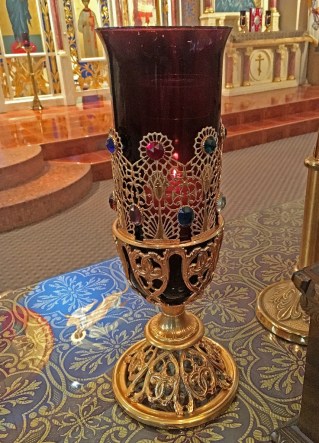
A blessed candle softly glimmers on the tetrapod for Nativity Fast. The angel image visible next to the candle is an inverted reflection of an icon from above the altar. ¹ The reflection is captured on the glass cover of the tetrapod. During Nativity Fast, we can reflect on the announcement by the Angel Gabriel to our Blessed Virgin Mary. Photo taken in St. Michael Church, Pittston, Pennsylvania
One of the lesser known fasting cycles occurs in Eastern Catholic churches and begins on November 15 and ends Christmas Eve.
Many people associate Advent with the approach of Christmas. Advent is the title given to the four weeks prior to Christmas in the Latin rite of the Catholic church. But there is another tradition called the Nativity Fast. Nativity Fast is a spiritual practice followed in Eastern Christian churches.
- It is a time set aside to spiritually prepare for the birth of our Lord Jesus Christ.
- The emphasis is reflecting on the mystery of the Incarnation of Jesus Christ.
- The Nativity Fast starts earlier than Advent. It begins the day after the feast of St. Philip on the Eastern Catholic liturgical calendar on November 15. This is how the fast became known by another title: Philip’s fast. Either title is used.
- The fast period is a full 40 days corresponding to the full 40 days of the Great Lent fast.
There is a bit of a difference between the Nativity Fast and Lenten Fast, though both are considered a fasting period. The Lenten fast is a very solemn, mandatory fasting period with specific practices in abstinence from food and participation in Lenten services. During Lent the dominant theme is penitential and sorrowful as a reminder of Christ’s death for our sins.
The Nativity Fast anticipates a joyful event. It may be described as an expectant fast; one filled with the wonder and promised hopes fulfilled by a coming Savior. Yet, it is a time of reserved joy in which practices of fasting (or abstinence) and almsgiving are encouraged. Abstinence is suggested as a spiritual discipline that helps to remind us where our focus should be. It is an invitation and a response. It is our “yes” to make room for Christ in our hearts.
- During the Nativity fast, the faithful may choose to abstain beyond what the Church normally suggests. In the Byzantine rite of the Catholic Church, this means going beyond the obligatory abstinence from meat on Fridays. (Byzantine Catholics have always maintained the practice of meatless Fridays. There are occasional exceptions during certain periods on the liturgical calendar.)
- The practice of almsgiving (providing and helping the poor) is advocated as equally important to the discipline of fasting or abstinence.
- Abstinence does not always have to be about food. Making time for spiritual activities in place of other activities is another form of abstinence. Or simply tuning out a lot of the distractions and noise around us is another form of making room in our hearts for God.
In our Ruthenian Metropolia, during the Philips Fast, abstinence from certain foods is encouraged. Abstinence from meat and dairy products may be voluntarily, partially, or in their entirety. Entirety would mean strict abstinence from meat and dairy on Mondays, Wednesdays, and Fridays, a mirror of the Byzantine rite Lenten Fast. And there could be lesser abstinence on Tuesdays and Thursdays, followed again by more strict, from Dec. 10th or Dec. 20th depending on local tradition. There would be mitigated abstinence on Saturday and Sunday.
While a strict abstinence is not unlike a Lenten fast, the voluntary nature of the Nativity Fast, allows the faithful to discern how to make this time spiritually enriching. And the discipline of a self-directed period of abstinence makes it even more personally relevant. For example, in addition to Friday, some may abstain from meat on Mondays and/or Wednesdays or perhaps abstain from other foods in addition to meat. It is voluntary in terms of level of fasting determined by each person.
What is important is not to become anxious to the point of being scrupulous on rules, rather than the intent of fasting. Our fast should be meaningful. We should not equate the formalities of practice for what may really matter to God, what is in our hearts. We must guard against practices for the sake of practices alone, taken up superficially with the wrong motivation, least we mistake the ritual as the purpose. We turn to Scripture for the wisdom that God teaches and values in this regard. The four Gospels and Epistles have much to offer for reflection during this time.
As with any fast, a God-directed focus is the virtue behind the discipline. Fasting or abstaining is a powerful deliberate act when “supercharged” with other activities we undertake. The renewal of our minds and opening of our hearts can lead us to a closer personal relationship with God. During the Nativity fast, we have an opportunity to be creative using a “both-and” approach. The time we have can be other-directed (in service to others), along with reserving time to be inner-directed (contemplative). Examples are almsgiving; quiet acts of charity; going to confession (the Sacrament of Reconciliation); engaging in Bible or religious study groups or online; replacing passive secular pursuits with Scripture and spiritual reading; listening to Catholic radio; tuning to Christian Christmas music rather than secular versions; watching homilies and lectures online; journaling reflections; and of course prayer.
Any practice that brings us closer to God is a good thing. When we abstain or fast (from food or activities) God sees our efforts. And even in our imperfections, God loves us no matter how weak we are or how many times we fail, when we put our trust in him.
The Nativity fast calls us to be inwardly joyful and reservedly expectant. It is a perfect time for contemplation. A time to prepare, not in an overwhelmingly way. Our frame of reference should always be as Christians and Catholics.
This is a time to consider the incomprehensible events unfolding: the role of Mary’s obedience to the will of God and her absolute trust in God; the anticipation of the birth of Jesus. We contemplate the great love God has for us in humbly assuming a human nature – the greater plan through which each of us is given the opportunity to share eternal life.
The Nativity Fast is about the mystery of the Incarnation of Our Lord and Savior Jesus Christ, and its relevance to our personal redemption and salvation. It is a plan of God that began long ago as we read in Old Testament Scripture the hopes and promises of a Messiah as foretold by the prophets. A plan for each and every one of us.
In the New Testament, we see again, many examples of waiting and hopeful expectation, of disciplined patience expressed by Jesus himself, even exasperation over human misunderstanding of his message to others. Jesus emphatically reminds his own apostles and disciples of the importance of prayer and fasting. He teaches that these are the means to affect change, whether in self or others.

Jesus is very patient. And in waiting we must also be patient. Hopeful expectation requires slowing down and acceptance of the wait. Keeping the intent of the Nativity fast can help us stay on track as Christians during a time when everything is moving in a frenzy. We can be examples of a Christian celebration, not one that our culture promotes.
The paradoxical and profound depth of God’s love for us is the balance and intersection between two realms, that of heaven and earth. God became human so we could become more like God (attributes of all Jesus calls us to be). The Nativity Fast is a purposeful and disciplined time to advance in our personal gratitude of God’s immense love for each of us. It is a sacrificial manifestation. We can look as well, to the role models of Mary and Joseph offer us to follow. Of their obedience and their trust.
Yet, we have great challenges during this period of time. An ever growing and modern day dilemma of all Christians is reserving time amid the busyness of shopping, decorating, and gathering with others. Of whether we have time left for what God desires more, our hearts. Often, we find ourselves tempted and sidetracked towards more of what we want, apart from God. Noise and distractions pull us in these directions. This is the background static we habitually revert towards to avoid what we fear — changes in being open to all that a personal relationship with God may require. What God offers and asks from us is very different than what the culture we live in wants us to possess. During this time of the Nativity fast, we can see how our Blessed Virgin Mary and Joseph responded in total faith to accept their call, to stay the course, a journey they had no knowledge of in advance. We must stay the course also.
♥ It is necessary to make a conscious choice to see beyond what the world identifies as worthy and important, and instead see with spiritual eyes.
The world may glorify a manufactured joy at this time of year, a joy without substance, but we can hold to our Christian beliefs in the midst of the secular disparity. We can follow tradition. We can celebrate the Glory of Our Lord at the exact time for celebration, beginning with our Christmas Vigil.
Our joy becomes the “joy of the Gospel” — the kind expressed by the early disciples of Christ — a joy that is continued in our present age, in our discipleship as Christians now. In doing so, we affirmatively acknowledge that Christ’s birth celebrated on Christmas Day is just the beginning. The Nativity of Jesus Christ is not merely a one day event forgotten and thrown away with all the wrappings the day after, but a revelation leading to the greatest gift of all. One that God gifts to all who accept his Truth.
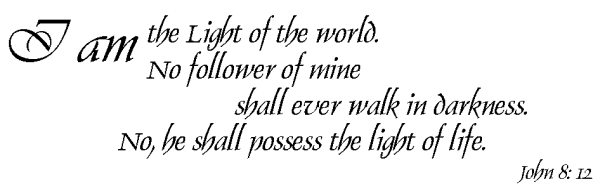
♥ Let us prepare our hearts to welcome Jesus, the true Light of the World
***
For additional details on the Nativity Fast practiced in the Byzantine Catholic rite of the Church:
Click Here: Metropolitan Cantor Institute, Nativity Fast
¹ Incarnation Icon: Icon of the Sign

 St. Michael's Byzantine Catholic Church