
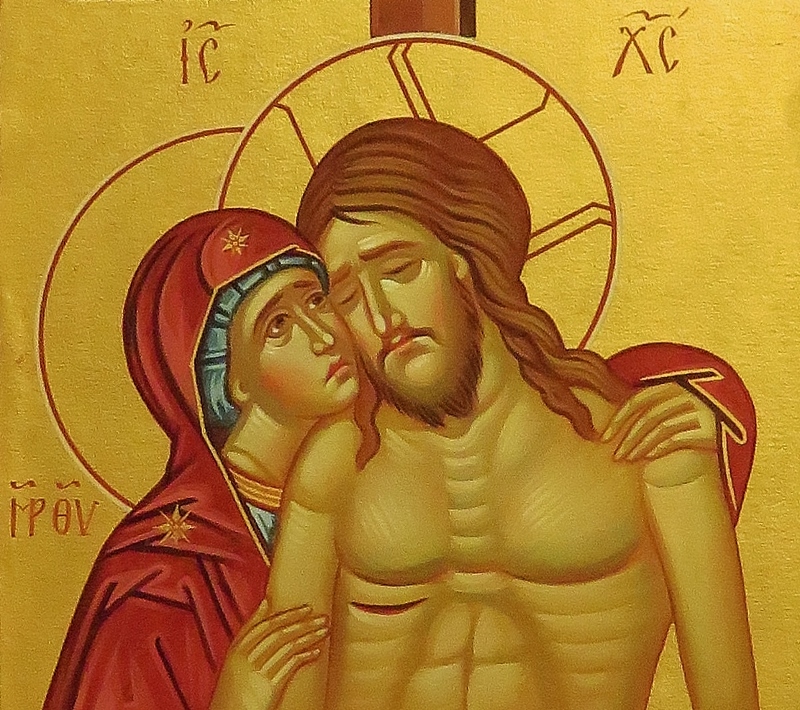
ICON OF EXTREME HUMILITY
The Liturgy of the Presanctified Gifts is a special liturgical service
present in both Byzantine and Orthodox churches during the Lenten Fast.During Lent, also known as The Great Fast, the Divine Liturgy
is celebrated only on Saturday (Vigil for Sunday) and Sunday, but not on weekdays.
The exception is the feast of the Annunciation of the Theotokos (Mother of God)
when it occurs on a weekday.
The Meaning and Form of Presanctified “Gifts”
The Catholic Church presents Lent as a special time of prayer, fasting, and almsgiving to prepare hearts and souls to fully receive a Resurrected Jesus Christ on Pascha (Easter). In the history of the Catholic church, some differences evolved in the manner and traditions practiced during Lent among the rites of the Church. For example, in Roman Catholic churches Mass is celebrated on weekdays during Lent. But in the Byzantine Catholic church, the weekdays of the Great Fast are aliturgicial, meaning there is no consecration of the Eucharist. Nonetheless, the faithful are given the opportunity to receive Eucharist, Holy Communion, at the Liturgy of the Presanctified Gifts on Wednesdays and Fridays.
The word Presanctified refers specifically to the form of Holy Communion distributed to the faithful during the Liturgy of the Presanctified Gifts. Holy Eucharist is reserved from Divine Liturgy celebrated the previous Sunday. In the Divine Liturgy, the consecration occurs during the part of the Liturgy called the Anaphora. There is no Anaphora during the Liturgy of the Presanctified. Instead, the reserved, consecrated Eucharist is distributed from the Holy Chalice in a customary manner. Hence origin of the term “presanctified”.
Historical Notes and Practices
Historically, due to the unique circumstances faced by immigrants arriving in the United States in the early 1900s, Lenten practices, not in accord with Byzantine tradition, were routinely practiced in our Byzantine Catholic churches (aka Greek Catholic in the homeland of Europe). For example, older parishioners today may recall participating in stations of the cross services on Fridays during Lent. And while “Stations” may have been present in Byzantine churches in the early 1900s and as late as the 1970s in America, and while they are certainly a very beautiful and endearing tradition, their inclusion was not an intrinsic part of our Eastern rite. This is not to imply one tradition is more meritorious over another, but rather to find value in preserving what is unique to our own.
The restoration of the Liturgy of the Presanctified Gifts during the 1980s and 1990s in Byzantine Churches in the United States was a major step in aligning practices as encouraged by every Pope since Vatican II. The overall goal has been to ensure that the various particular churches (sui juris) in the universal Catholic Church preserve their diversity and uniqueness, while in unity with the “one holy Catholic and apostolic church”.
Why Presanctified
The basis for the Liturgy of the Presanctified Gifts is rather simple: Lent is a time of repentance; and since every Divine Liturgy is a Day of Resurrection, our celebration of the Resurrection of Christ, and since Lent is a penitential period of preparation to celebrate Pascha, the Divine Liturgy during the Lenten period is reserved to Sunday liturgies. The origins of this Eastern perspective originate as far back as the fourth century of the Catholic Church. It is interesting to note that parts of the Liturgy of the Presanctified Gifts were formulated in the sixth century in Antioch, Syria and have developed over time.
Byzantine Catholic churches offer the Liturgy of the Presanctified Gifts twice each week as prescribed on Wednesdays and Fridays. This is done during the six weeks of the Great Fast. The Liturgy of the Presanctified Gifts is also held on the first three days of Great and Holy Week, the final week leading up to Easter (Pascha). Great and Holy Week is commemorated in Byzantine churches as a week that is significantly more solemn in tone than the weeks of the Great Fast.
During Great and Holy Week the faithful are invited on a journey of meditation upon the most significant events preceeding our Lord’s Resurrection on Pascha, Easter Sunday. These are the events of the initiation of the Eucharist by Jesus Christ to his apostles on Holy Thursday, and on the Passion of our Lord leading to his crucifixion on Good Friday and his burial and waiting period of Holy Saturday.
The Beauty of the Presanctified Liturgy
The Liturgy of the Presanctified Gifts is composed of many Vesper prayers and hymns chanted by the faithful leading up to reception of Holy Communion. The Liturgy begins with the responsorial chanting of Psalm 103 (Bless the Lord, O my soul! Lord my God, how great you are!). This is followed by litanies of supplication, antiphonal psalms that are chanted and the beloved “Hymn of the Evening” (O Joyful Light). The Liturgy also includes readings from the Old Testament (Genesis, Proverbs, and during Holy Week from Exodus, Job, and the Gospel of Matthew) to remind us how the plan of salvation was a plan that God had made for us from the very beginning. The liturgy also includes a beautiful and solemn blessing of all present by the priest making the sign of the cross with a lit raised candle. This reminds us that even in all the darkness of our world we are illuminated in our knowledge of Christ as the priest entones, “The light of Christ enlightens everyone.” There are many features unique to the Liturgy of the Presanctified. Among these is recitation of the Prayer of St. Ephrem by all present, as well as a solemn incensing of the Holy Table in which the faithful sing: “Let my prayer ascend to you like incense, and the lifting up of my hands like an evening sacrifice”.
Lenten Hymn at Conclusion of Liturgy
A very impassioned hymn is sung at the close of the Liturgy. This is also a tradition that is very dear and close to heart of Ruthenian ancestry. It is not difficult for those with ancestry traceable to the regions around the Carpathian mountains, to imagine generations upon generations of ancestors singing this hymn and prostrating at the end of each verse in dimly lit, hand constructed wooden churches. Traditionally today, the the verses are sung alternately in English and Church Slavonic (the liturgical language developed by the Apostles to the Slavs, Ss. Cyril and Methodius). This hymn is sung in a very deeply sensed way that evokes sadness as the words encapsulate so simply the character of Lent — our invitation to meditate with Christ in his Passion.
Having suffered / the Passion for us / Jesus Christ / Son of God
Have mercy / have mercy / have mercy on usPreterp’ivyj / za nas strasti / Isuse Christe / Syne Bozij
Pomiluj / pomiluj / pomiluj nas
Invitation to Witness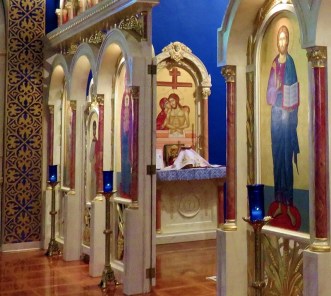
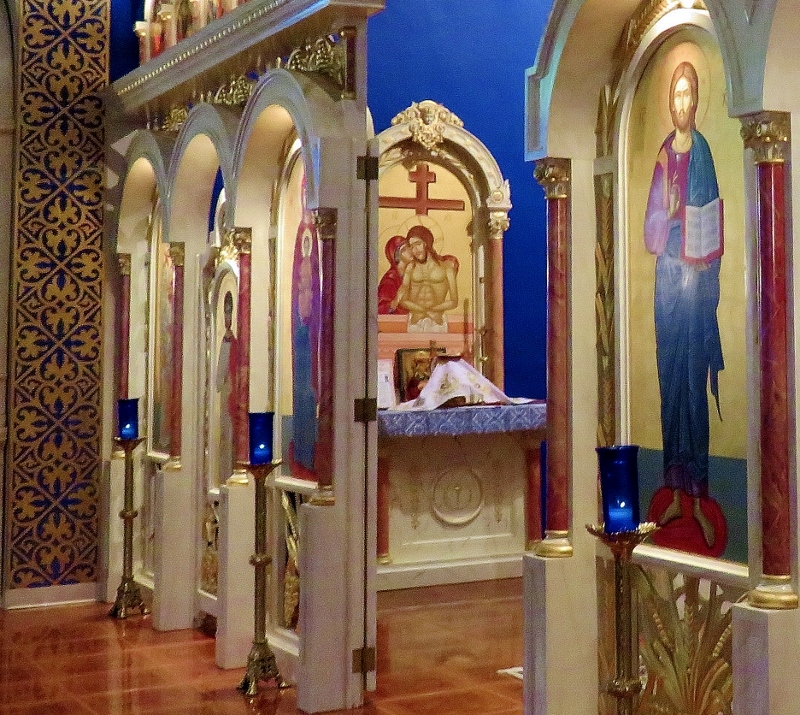
All who have an opportunity to attend Liturgy of the Presanctified Gifts are participating in a beautifully reverent service with foundations in the early centuries of the church. It is a service in keeping with the themes of the Great Fast; an enlightening time for the faithful to focus on the context of God’s plan for salvation.
We invite everyone to witness the special traditions of our Eastern rite by attending this Lenten service. All practicing Catholics may receive Holy Communion in a Byzantine Catholic.
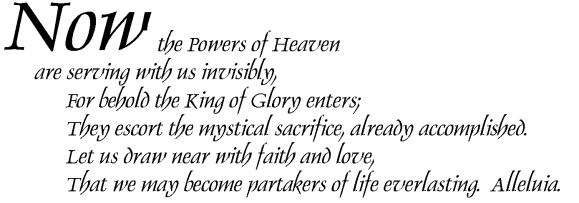

 St. Michael's Byzantine Catholic Church