The Diversity of the Catholic Church
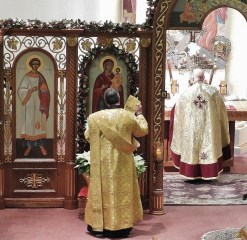
“Commemorating our most holy, most pure, most blessed and glorious Lady, the Theotokos and Ever-Virgin Mary with all the saints, let us commit ourselves and one another and our whole life to Christ our God.” Deacon intones prayer in front of the icon of the Mother of God.
The Catholic Church is one church, united in one faith, expressed in different rites.
The Catholic Church is the one Universal Church established by Jesus Christ — the very beginning of Christianity — with a mission to preach to the world the revelations and Truth of the faith taught by Christ, passed onto the apostles and all believers. To be Catholic is to accept all that Christ taught during his ministry and to live the faith as missionary disciples of this Truth to others. All Catholics are Christians, in fact, the first Christians. All Catholics by virtue of their baptism are mandated to living their faith, and in supporting the mission of the Church, of proclaiming the message of salvation in the fullness of Truth.
Christ chose twelve men as apostles, instituting them as an assembly. He placed Peter, one of the twelve, as the earthly shepherd of the Church. This goverance gave form to the way early Christians established communities. And those communities grew and were united in their continuity to those twelve apostles through Christ. Both Catholic and Orthdox believers trace their history directly to Christ and the begining of Christianity. As a result, both also have valid Holy Orders (an ordained priesthood) through this unbroken apostolic succession. Catholics believe that Christ governs the Church through the successors of Peter and the apostles: through the Pope (Bishop of Rome) and the bishops united with him and to each other.
The Catholic church is richly blessed in having many diverse expressions of the true faith. These are known as rites. The Roman (Western) Catholic church is one of the rites, and there are many other rites collectively referred to as Eastern Catholic Churches.
Saint John Paul II clearly articulated this diversity present in the Catholic Church. He spoke of two lungs of the Church, East and West that breathe together. The entire Catholic Church is like a family tree in many ways, but one united by a common bond to Jesus Christ, and sharing the same valid Sacraments. All of the various rites in the Catholic Church are commissioned to maintain the richness of their own expressions of faith and theology to the benefit of all. Each follows one of the six different rites or liturgical forms.¹ In addition, among the Eastern Catholic Churches are 23 different particular or sui iuris Churches with their own cultural traditions and heritage that developed from their geographical and historical roots. Sui iuris means autonomous or self-governing, yet these churches, as Catholic Churches are in communion with each other and with the Bishop of Rome, the Pope.
A Shared History of Apostolic Roots

How did this diversity come about? And why is it necessary?
The apostles and disciples of Christ evangelized the gospel to different parts of the world. They preached the same message of Christ, but to people of many varied cultures and languages. Christianity was diverse from its very beginning. In the eastern portion of the Roman empire, Greek was the dominant culture and language. Whereas in the western portion, Latin became established.
Christianity flourished in the cultural hubs of the Mediterranean. These centers of faith were areas where communities of believers in Jesus Christ grew in number and churches were established with appointed bishops. The main centers of early Christianity were: Rome, Antioch (Syria), Jerusalem, and Alexandria. From these communities, the message of the Gospel dispersed to more distant lands. The Gospel was not limited to a few, but intended to be announced to all people. Therefore, the diversity of the Church was a result of Christians fulfilling the mission of the Church.
Christian, Catholic and orthodox from the beginning
As church communities expanded geographically, the language and culture of the various regions influenced liturgical expressions. While these influences led to differences in expression, the central elements — structure of liturgy, the primacy of apostolic succession, the Sacraments, and adherence to essential teachings — united all as one universal church.
Finally, it should be noted that Eastern Orthodox churches, those not currently united with the Catholic Church in communion with the Bishop of Rome (the Pope) do share a profound heritage with the Catholic Church. Eastern Orthodox churches share the same source of Holy Orders and the Sacraments from Christ through apostolic succession. This means that Eastern Orthodox churches have the same valid Sacraments. Many of the Eastern rite Catholic Churches have liturgical and theological expressions parallel to their Orthodox brothers and sisters in Christ. We pray for eventual unity among Orthodox and Catholic Christians.
A Common Belief in the Real Presence of Christ in the Eucharist

The sum and summit of the Catholic Church and what unites its believers is the Eucharist. This is the mystery of the Holy Sacrifice given to the Church by Jesus at the Last Supper wherein bread and wine are transformed, consecrated, into His Real Presence — Body, Blood, Soul and Divinity of Jesus Christ present in the Eucharist. The Eucharist is what unites the faithful and the entire community of saints — past, present and future — to the Living Body of Jesus Christ. Our Life in Christ is the Eucharist. Jesus is the Eurcharist. And Jesus definitively states in Holy Scripture, “Amen, amen, I say to you, unless you eat the flesh of the Son of Man and drink his blood, you do not have life within you.” (Gospel of John, Chapter 6, verse 53). In the Words of Jesus, we find he was not referring to His Living Body, the Eucharist, merely as a symbol or metaphor. Jesus is present in the Eucharist. Jesus is THE Eucharist. And, to be Catholic, is to believe in all that Christ revealed. God does not expect us to comprehend something that the limits of our minds cannot, but rather to believe in faith. This is why Eastern Catholics refer to all of the Sacraments of the Church as “Mysteries”.
The belief in the Real Presence is what distinguishes Catholics and Eastern Orthodox faithful from other branches of Christian worship. It is also why apostolic succession plays such an important role.
In Eastern Christian tradition, the term “Divine Liturgy” or simply “Liturgy” is used instead of the term “Mass”. The word liturgy comes from Greek for public service or work.
Eastern and Latin churches share the same basic structure of liturgy. In Eastern churches there are three sequences in each Divine Liturgy: The Liturgy of Preparation or Offering (Proskomedia), Liturgy of the Word and Liturgy of Sacrifice or Eucharist. Only validly ordained priests can preside at the Eucharist. There are two liturgies used in the Byzantine rite. The Liturgy of St. John Chrysostom is celebrated throughout the year. The Liturgy of St. Basil the Great is celebrated at select times on the Eastern liturgical calendar. Both liturgies are beautiful forms of worship presented in a way that has been described as heavenly. In many ways that is accurate, as during liturgy we unite ourselves to the communion of saints who have gone before us and to all of the heavenly choirs of angels in a mystical way that transcends time. The anaphora of the Liturgy of St. Basil has the most eloguent and profound prayers that describe our relationship to God and all creation. The anaphora is the part of the liturgy during which the common elements of bread and wine are consecrated through the power of the Holy Spirit and become the Most Precious Body and Blood of Jesus Christ.
St. Michael the Archangel Byzantine Catholic Church, Pittston, is an Eastern Catholic Church of the Byzantine rite, with Carpatho-Rusyn (Ruthenian) traditions. Use the search box on the home page to find more on the history of our Carpatho-Rusyn heritage.
For those New and Not-so-New
attending a Byzantine Catholic Church service
Does Attending a Byzantine Catholic Divine Liturgy fulfill my Mass obligation as a Catholic?
The answer is absolutely yes! Catholic is Catholic. Attending a Divine Liturgy meets the same standard obligation required for all Catholics. Naturally, there will be differences in liturgical expressions, such as the hymns sung will be unfamiliar, vestments the priest wears, and so on, but it is the same celebration of the Mass in all the essential ways.
What will I experience?
Divine Liturgy and all Byzantine Catholic services are a dialogue of prayer, between the priest, deacons and parishioners in the form of hymns that are chanted. In other words, the whole liurgy is sung. In the Divine Liturgy, there is an elevated sense of reverence, respect, and dignity to all that is taking place. The only prayer that is spoken as a group recitation and not sung in a Divine Liturgy is “The Prayer Before Holy Communion“. Otherwise, every part is chanted. Some of the hymns are based on the psalms. Others profess our Catholic faith. And the many of the eloquent words of the priest in blessings and prayers he recites are directly from Holy Scripture. A cantor leads the faithful in singing. Our prayer is our singing. Therefore, singing is our offering of our prayers in worship .
How will I know what to do?
Like any new experience, many things will feel different. Find a place to sit where you will be comfortable and can see a view of the icon screen and altar. To get the most from your first visit, simply observe, watch and listen. During a first visit, do not spend time trying to find the correct page or text in the pew books. Just listen and watch. There is a lot to experience that is new in all that you will be seeing, hearing, smelling (incense) and sensing. Divine Liturgy is often described as being very transcendent.
How should I enter the church?
If you are a new visitor, directly proceed to a pew as you would in any church. You may make the sign of the cross and / or bow slighly before entering the pew. Byzantine Catholics do not genuflect. Bowing is the norm instead. After entering the pew, you may either kneel to say your prayers before Liturgy, or if comfortable stand in place to pray. You will observe people doing either, which is acceptable in our parish custom. When done praying, sit until Liturgy begins and the congregation stands in unison.
A traditional proper church “etiquette” for Byzantine Catholics on entering the church is to walk up the center aisle, approach the small table (called a tetrapod), bow slightly while making the sign of the cross, and venerate the icon on the tetrapod. Then stay in place to make two more signs of the cross, and proceed to a pew.
We venerate icons by kissing the icon *** (see footnote regarding precautions). It is fine to kiss any part of the icon but not really so polite to kiss the face or lips of the figure in the icon. Children at an early age can be taught this very special form of respect, and a parent can lift up a child to teach them how to venerate icons from an early age.6 For more about the use of icons, click on the word “Icons” on the main menu.
Can I receive Holy Communion?
If you are a practicing Catholic, not in a state of mortal sin, as in any other Catholic church, you may receive Holy Communion in any Eastern rite Catholic church. Holy Communion is received in both species at the same time. It is the real Presence of God. In the Byzantine rite, Holy Communion is in the form of small cubes of leavened bread placed in a chalice (intinction) with wine and a small amount of water. The Hosts are smaller than a sugar cube. When the words of consecration are spoken by the priest, through the power of the Holy Spirit, the bread and wine become the Body and Blood of Jesus Christ. We call this “Transubstantiation.”
If you do not wish to receive Communion when attending Liturgy, that is perfectly acceptable. You may remain standing or seated until all going to Communion have received.
I’m nervous about receiving Holy Communion in the Eastern rite
Byzantine Catholics are accustomed to receiving from a common chalice in the way described below, from the time they were children.
Traditionally, the priest uses a very small spoon to skillfully drop a particle of the Blessed Sacrament into the communicant’s mouth with no contact made with the spoon at all. Some churches may continue to distribute Holy Communion in the style implemented during the COVID pandemic, out of an abundance of caution and for the comfort of all communicants. But at our parish, we follow the traditional Byzantine practice.
The method of receiving is this: Simply, open your mouth very wide as if at the dentist. Do not extend your tongue. The priest will place the Host in your mouth by flipping the spoon over so the host drops inside your mouth. If you follow this instruction, there is never any contact with the spoon.
To prevent any chance of stray particles or any part of the Sacrament from falling, it is important to gently take hold of the long linen cloth (the priest drapes down in front of the chalice) in your hands without tugging, and place it under your chin. Release the cloth after you receive the Sacrament. Walk away to the side and make the sign of the cross. Return to the pew. Remain standing, or if the line is excessively long, you may sit, and then stand as the last communicant finishes receiving the Sacrament.
If you cannot consume gluten, our churches do not have gluten free hosts since we use leavened bread, and not the flat wafer used in the Latin rite. While you might ask for a blessing, we do not follow the Roman rite practice of crossing hands over the chest as a signal to receive one.
Communicants are not required to say “Amen” before receiving Communion. This is because the priest is saying a beautiful prayer on behalf of each communicant. He also states the name of each communicant! You can quietly tell him your first name if you wish.
These small differences should not deter anyone from receiving Holy Communion for the first time in an Eastern church.
I see the priest giving Communion to infants and toddlers! How is that permitted?
Eastern rite Catholics follow a different rule on how the Sacraments of Initiation (Baptism, Chrismation, Eucharist) are given. In our Byzantine Catholic church, infants are baptized, then immediately following are “chrismated” (confirmed) receiving the seal of the Holy Spirit, followed by receiving a small amount of Holy Communion. The priest performs all 3 Sacraments in that order at the same baptismal ceremony. It was only much later in the history of the Catholic Church of the Western or Latin rite that these Sacraments were “separated”, with First Eucharist and then Confirmation being reserved until children were older for various reasons. In Eastern churches however, since infants have already partaken of Holy Communion following their Baptism and Christmation, they continue to receive Holy Communion without interruption regardless of how young they are.
In Byzantine and Orthodox traditions, this practice was retained from how it was done in the early church. We believe that children should receive the graces that come from the Holy Spirit through Chrismation and Eucharist along with Baptism. Children in Byzantine churches also participate in traditional catechetical instruction so as they grow in age, they also grow in understanding of their faith. A formal ceremony of First Penance and Holy Communion is held at the determined traditional age of reason.
Why is everyone standing during the Holy Consecration of the Gifts?
Ir may seem awkward to stand during the moment when the words of Institution or Consecration of the holy gifts (ie., “This is My Body; This is My Blood..) is taking place. Especially if you are used to kneeling at that time. This is where there is a different theological view of how the East approaches this part of the Liturgy. The Eastern churches engage and invite the faithful to participate actively in worship. A part of this is bodily postures and how those postures are both symbolic and in harmony with what we believe and profess. Sunday is the day of Resurrection. Each celebration of Liturgy is a mystical participation with all creation, the heavenly hosts, communion of saints in glory with our Risen Savior. It is a kind of exaltation stance, not a penitential stance we assume because in this mystery where time and space are suspended, we are united to Christ and honor his glorification as King. In the tradition of the East one rises to respect the presence of a King, just as we do if a dignitary enters a room.
There are a limited and select number of times Byzantine Catholics kneel in liturgical practices. We kneel at certain services during Lent, such as during the Liturgies of the Presanctified Gifts. During Lent (called the Great Fast), a more pronounced form of deeply spiritual bowing or type of kneeling, called a prostration, is a traditional posture made in the Eastern churches. We also traditionally kneel as we approach the image of our crucified Lord, imprinted on a Holy Shroud, on Good Friday. Finally, we kneel on Pentecost Sunday during the prayer we recite with the priest to ask for the blessings and protection of the Holy Spirit.
Do I sit or do I stand?
When new, it’s best to follow what others do. While the books for a service may indicate when to sit/stand, the guiding principle is observe, to stand or sit based on what is taking place in “real time”. Even seasoned Byzantine Catholics may sometimes mix up when to sit/stand. It is a matter of adjusting to what is happening in the moment.
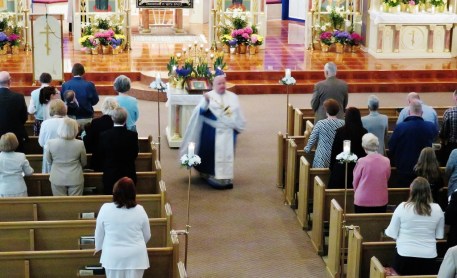 Incensing: The deacon or priest will often incense the people or church at different times. The proper posture is to always stand during any incensing. You can return to sitting after the incensing ends. Again, just follow the lead of others present. In blessings with incense, such as at the start of Liturgy, everyone should make a slight bow or sign of the cross. Whenever a deacon is present, the deacon will usually incense the church, congregation, and icons during different parts of the Liturgy. The incensing of the congregation present for liturgies is to remind all who are baptised they are created in the image of Christ and are temples of the Holy Spirit. Through the graces we receive in the Sacraments of the Church we are in the process of growing closer to God in holiness (Theosis).
Litanies: Litanies are a series of chanted prayer petitions. The congregation usually sits during these prayers that often carry a response of “Lord have mercy”.
Blessings by the priest: When the priest turns to bless the congregation with his hand, cross, chalice, gospel book – the posture is to stand. There are a few exceptions that may occur, such as during Lenten services when kneeling is allowed.
Why isn’t there an organ, piano, guitar or other musical instrument in use?
In Byzantine churches, singing is our form of prayer. And while not all of us are talented singers, like a loving Father, God accepts us as we are and loves us in our effort, no matter how imperfect or elegant. God values our humility and willingness to try more than our fear of what others may think. Unless there is a physical reason, we should make every attempt to participate in this way. Our ancestors did not have the means other than use of their own voices to worship, and like the poor widow’s offering, God values all we have to offer.
Entering into worship with our voices is among the greatest gifts we can personally give to God. We are engaged when we participate in this way. In singing, we are united with each other as a parish family, along with the priest, the communion of saints, heavenly hosts, and with God in the timeless mystery of our offering of praise and in the sacrifice of Christ in the Holy Eucharist,
Why is everyone making the sign of the cross so much?
We bless ourselves with the sign of the cross very frequently during Liturgy and every time we sing “Glory be…” or whenever the Holy Trinity is named. The sign of the cross is a physical demonstration of our personal belief in the salvation promised to us by Jesus in his death on a cross and in his resurrection. Each time we make the sign of the cross we acknowledge the mystery of the Trinity (Father, Son, and Holy Spirit). It is no small action to actively participate in this way during the Divine Liturgy. We bless ourselves in response to every time the priest faces us and offers blessings that we graciously receive. Making the sign of the cross this often is a wonderful practice to try ! It means we are paying attention and not passive! But actually, it is a personal expression of faith made visible through our prayer-filled and active involvement in our liturgies. Don’t worry you may be making the sign left to right, instead of right to left as done in the Byzantine church. What matters is that making the cross is meaningful.
Liturgy ended, but everyone is forming a line and approaching the priest. Why? What is this blessing people are getting?
If you attend a Sunday Liturgy that is a Feast Day, or if there was a Holy day during the week, after Liturgy ends, the faithful will receive a special blessing with blessed oil. It may look like a line to receive Holy Communion, but it is not. You are most welcome to go join with parishioners for this blessing. The priest will put a little dab of blessed oil on your forehead and greet you . If you see an altar server off to the side, holding a small basket filled with cubes of bread, be sure to take some of the bread. This blessed festal bread is a symbol of carrying our faith with us as we leave the church. We consume this bread with faith and express our trust in Christ. Enjoy this special blessing !
We hope this is helpful in alleviating any hesitation you may have in trying a new experience of attending one of our Byzantine Liturgies or services. We welcome all visitors and encourage you to introduce yourself and ask further questions.
Be sure to join us during Lent at one of our Sunday Vesper Services.
The service is an opportunity to experience Byzantine chant style in a setting where visitors from many parishes join together.
Traditional Greetings said during Liturgical Seasons:
- “Christ is Among Us” Response: “He is and always will be” (General)
- “Christ is Risen” Response: “Indeed He is risen!” (Easter)
- “Christ is Born!” Response: “Glorify Him” (Christmas)
“Glory to Jesus Christ!”
“Glory to Him forever!”
¹The following list shows the six rites of the Catholic Church.
Latin (Western) Catholic Church:
Latin rite
Eastern Catholic Churches:
Armenian rite
Alexandrian rite
Byzantine rite
East Syrian or Chaldean rite
West Syrian or Antiochene rite

 St. Michael's Byzantine Catholic Church